Home Economics
Goals of Home Economics
- 1To acquire the basic knowledge and skills for daily life through activities and experiences related to food, clothing, shelter, and other essential needs.
- 2To develop a sense of one’s role as a member of a group (team, school class, home) and the ability to try and improve one’s home life, through cooperative activities with peers.
Points of focus
- Home Economics is a subject that relates directly to daily life. In addition to learning and understanding new things, students use their hands to apply what they learn to their daily lives.
- In cooking classes, students use organic pesticide-free daikon radishes that they grow in their science classes, and with the cooperation of a nutritionist, they work in groups to design well-balanced school lunch menus. They also learn to feel gratitude for food ingredients and the many people that help to produce the meals they eat each day.
Essential ideas for lessons
Outline
Grade 5 students focus on fundamental skills, while Grade 6 students learn more advanced techniques.
In the area of food, students learn cutting, boiling, frying, and other basic cooking skills.
In sewing, students learn to sew both by hand and using a sewing machine.
Through these experiences, students learn important skills to maintain their everyday life.
Learning from others
Home Economics is a subject that is very relevant to life and living. Learning home economics is much more than just studying and absorbing knowledge. At the Primary School, we place importance on getting students to reflect on their attitude to life and put what they learn directly into practice.
For this reason, we incorporate as many hands-on work opportunities and activities as possible. As they make items and cook, we also try to get students to teach each other and cooperate effectively.
Through such activities, students achieve more than just acquiring specific skills; they also learn how wonderful it is to cooperate with their peers.
Adapting to life
We work actively to develop educational content that allows students to apply what they learn in their daily lives. In preparation for the Numazu Swimming Camp in Grade 6, students sew cleaning clothes that can be used during the visit, learn the merits of traditional Japanese houses by comparing them with contemporary houses, and learn about the theory of cleaning and hand-washing. By directly experiencing these things anew in the camp, they can apply them to their home life.
During long vacations, students may be asked to help out at home as an assignment. No matter how small a task may be, we encourage students to tackle it with a sense of being a member of a family.
Classes
Cooking practice using vegetables harvested from Kinkoen Garden
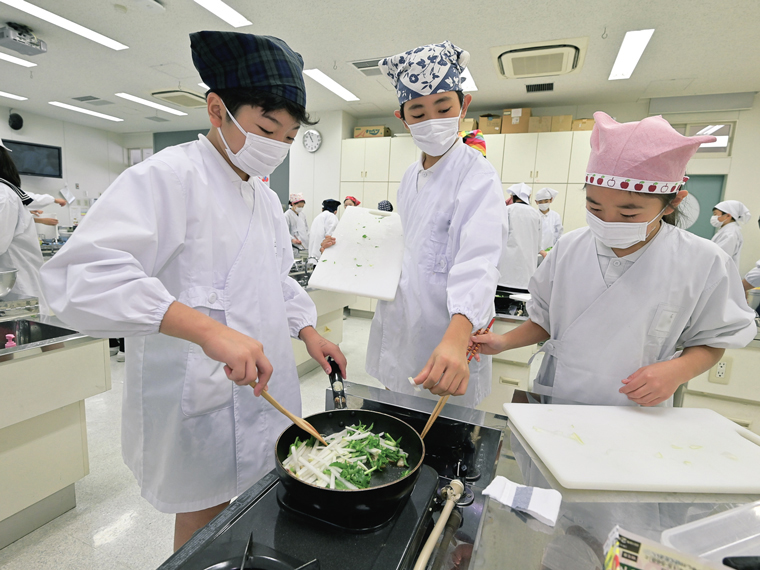
A scene of cooking practice with daikon radish leaves. They are cooked together with chirimenjako (dried baby sardines) and abura-age (deep-fried tofu).
Grade 6 students grow sweet potatoes and daikon radish as part of their science studies. These ingredients are actively used in cooking classes.
Children learn how the food they eat every day is grown and produced, and they experience the joy of harvesting it themselves. Then, by taking what they harvest home and cooking it, they develop confidence in cooking and a deeper understanding of the value of food and farming.
For example, we use daikon radish leaves in cooking classes. Although daikon radishes with leaves are rarely seen in stores these days, the leaves are rich in nutrients. In the past, they were popular vegetable to eat.
ating and cooking daikon radish without wasting any part of the plant is a good way to get nutrients. Furthermore, it is environmentally friendly, because less vegetable waste is produced. Plants are living organisms too. Student learn to keep in mind that their life is sustained by the life of living organisms, so they should eat whatever they can without wasting food unnecessarily.
Learning about diet through school lunches
In the minds of children in Japan, school lunches are an ingrained part of school life, so they can serve as an excellent model for a healthy diet and eating habits.
At Gakushuin Primary School, lunches are prepared at the school kitchen. Students also have the opportunity to plan school lunch menus along with a dietitian with a teaching certificate.
However, creating a menu consisting only of food that children want to eat is not appropriate for school lunches. By asking the question, “What kind of menu is suitable for school lunches?” students deepen their understanding of healthy eating habits.
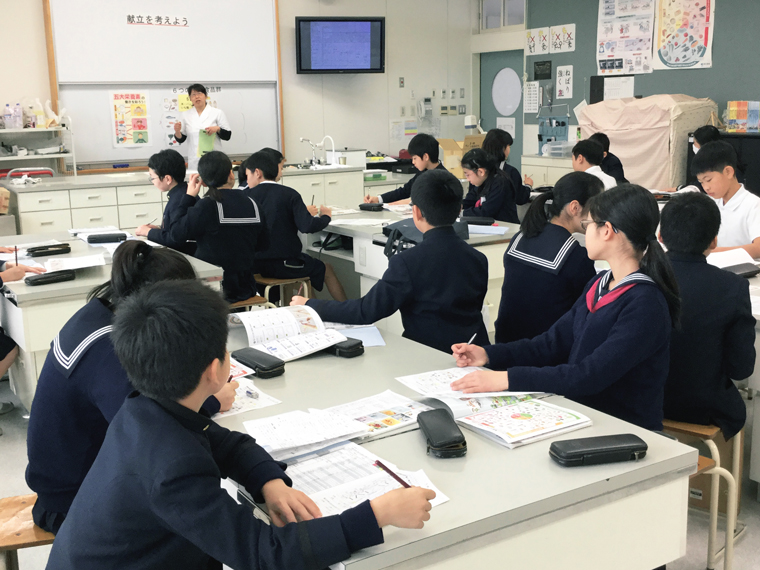
A nutritionist in the classroom. Nutritionists are actively involved in cooking lessons.
The first concrete step is to prepare staple food, a main dish, and side dishes, making sure they have a balanced mix of the five major nutrients. Next, through repeated discussions among the whole class, the students decide on a menu for one meal, taking into account various matters such as using seasonal ingredients, matching with events, and incorporating pleasing colour combinations.
Then, if a nutritionist judges the menu to be nutritionally balanced and appropriate for a meal, the menu may actually be served for a school lunch. The children tackle this challenge enthusiastically because the dishes they design may be served for the school lunches that they eat every day.
Learning about rice
Grade 5 students learn about rice cultivation in their Social Studies classes. In Science class, rice seeds and seedlings are distributed to students who want them. The students can plant them to grow and harvest “bucket rice” at home.
In Home Economics, students practice cooking rice and miso soup. Rice is prepared in a pot over a gas flame, rather than using an electric rice cooker. The miso soup is made with niboshi (dried sardines) instead of chemical seasonings.
Although the meal is designed to be simple, the children love it more than anything. The fragrant smell of rice cooked over an open flame and the natural aroma of dashi (soup stock) delight the students.
Like this, the students learn about rice, the staple food of the Japanese people, from a variety of perspectives.
Making hand-sewn items
In Grade 5, students learn to sew by hand.
With ready-made fabric goods now available at low prices, there are fewer opportunities to sew at home. Nevertheless, the sewing skills that they learn in Grade 5 will be useful to students, even after they become adults. In addition to being a useful skill, sewing also helps students to develop mental concentration.
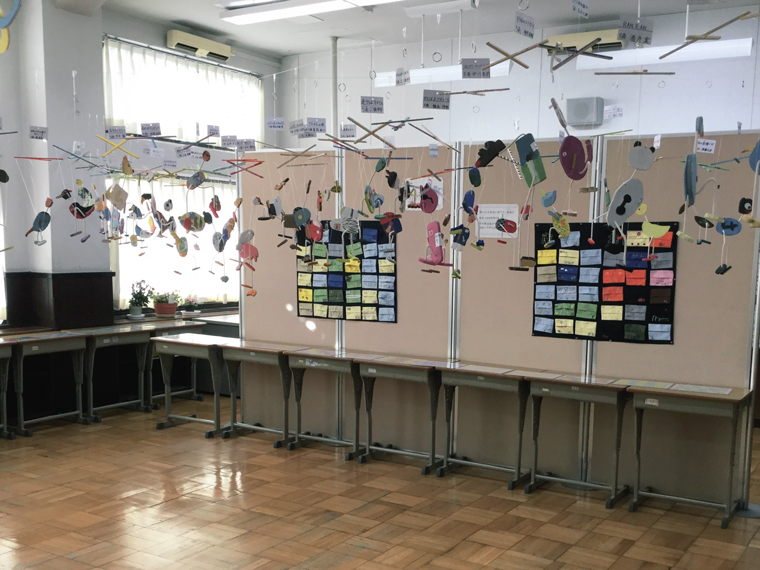
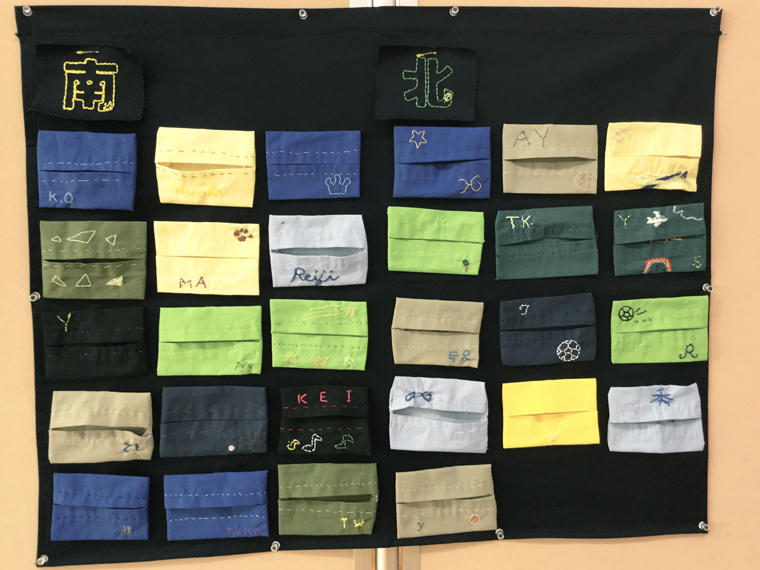
Hand-sewn pocket tissue cases displayed at the Primary School Festival. The students chose the colours of the cloth and embroidery (e.g., names) themselves.
For children who have never used a needle and thread, merely threading a needle and tying a knot can be challenging. In situations like this, the students can effectively learn the basic skills by working cooperatively in groups.
For example, they make pocket tissue cases. It is only a small item, but it involves basic sewing skills. Since students can make practical use of the tissue case, they not only get to experience the pleasure of making it but also the satisfaction of using something they made themselves.
Making items using a sewing machine
In Grade 6, students focus on machine sewing.
Using a sewing machine makes it possible to sew quickly, with strong and precise stitches. It also greatly expands the possibilities of sewing.
Since there are plenty of sewing machines, students can work at their own pace without needing to wait their turn.
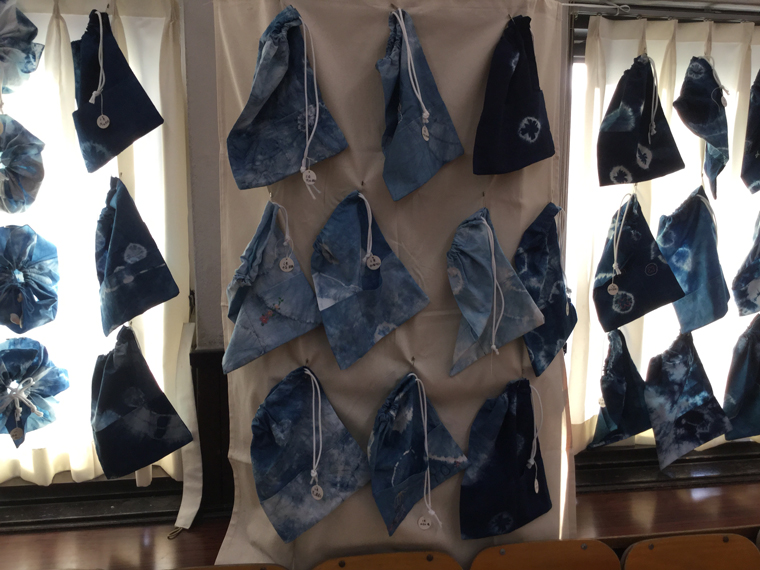
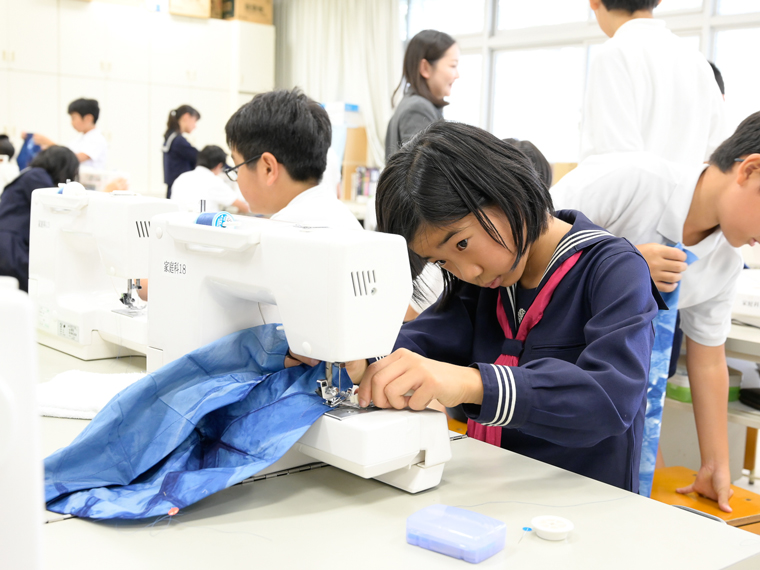
Bags made from handkerchiefs on display at the Primary School Festival. Students dyed the handkerchiefs with indigo harvested at school.
Classrooms
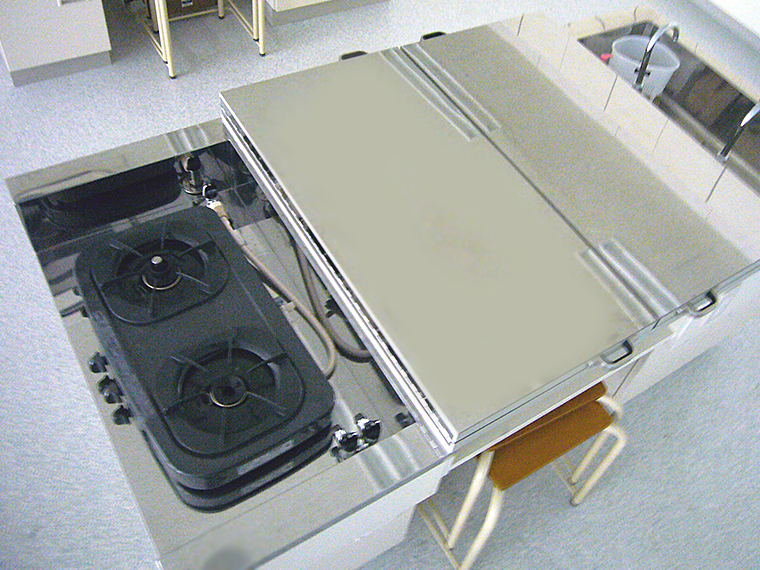
Desks in the Integrated Studies classroom (top panel open)
Students study in the Integrated Studies classroom that is used for both home economics and science classes.
Since sewing and cooking require a large amount of space, these classrooms are fitted with larger desks. The aisles between the desks are also spacious.
For cooking, the tops of the desks can be opened to reveal a stainless-steel surface, designed to be hygienic, as well as a sink and gas stove. Equipping each desk with a sink and gas stove reduces the amount of human movement, making the cooking practice of students safer and more efficient.