Language Studies (Japanese)
Goals of Japanese Language
- 1To develop the ability to correctly speak, listen, write, and read Japanese without neglecting any of the fundamentals or basic principles of the language.
- 2To experience the enjoyment of use of Japanese through speaking, listening, writing, and reading the language.
- 3To broaden one's mind by reflecting on one's own life as well as becoming more aware of other people's views and ideas.
Points of focus
- Speaking, listening, writing, and reading are the foundations for learning in all subjects. To train students to become skilled Japanese-language communicators, Japanese-language education at Gakushuin Primary School strives for rigorous instruction and guidance, without neglecting any fundamentals or basic principles.
- Educational content focused on the ability to speak, listen, write, and read Japanese correctly is taught from a perspective that spans all six years of elementary school education. While good use of textbooks is made, lessons are systematically formulated and conducted using original teaching materials created by Gakushuin.
- To become skilled Japanese-language communicators, it is vital not only to learn how to use the language correctly, but also to cultivate a rich aesthetic feeling and sensibility for the language. Instruction and guidance are designed for elementary school level so that students broaden their minds in the process of learning from one another.
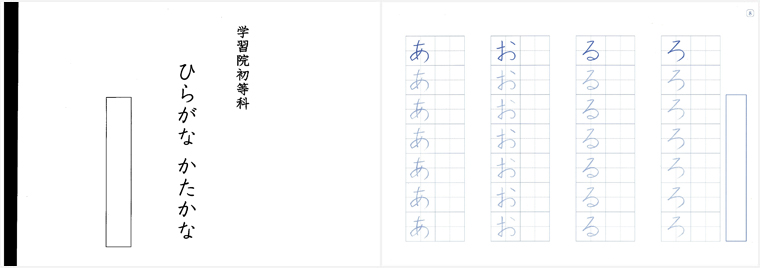
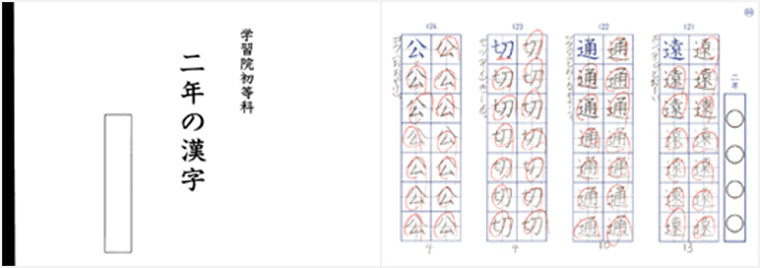
Write correctly and beautifully
In our daily lessons, we place special emphasis on learning how to write letters beautifully and in the correct form. To this end, we have worked on creating a unique practice book for Gakushuin Elementary School.
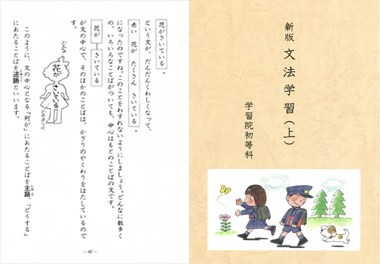
Use the correct words
I sometimes hear people say, ``My Japanese is confusing.'' By studying Japanese grammar systematically, you can acquire both correct knowledge and skills. For six years, we have been teaching Japanese grammar using our own grammar study texts. Read the explanations and add them as you write.
Improve your expression
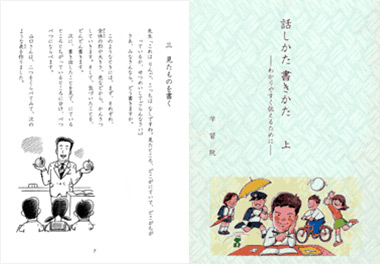
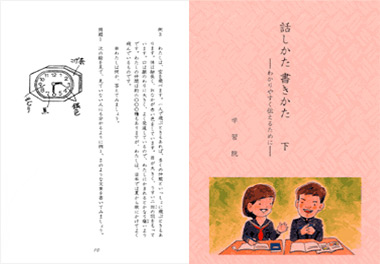
As a teaching material for "methods of expression," we use a unique text called "How to speak and write" for second to fifth grade students. It was created by teachers from elementary school to university. We teach students how to express themselves in a logical manner while distinguishing between facts and opinions.
learn from each other
In general, learning activities are designed to shift from individual activities to collective activities, and appropriate opportunities for discussion and presentations are incorporated.
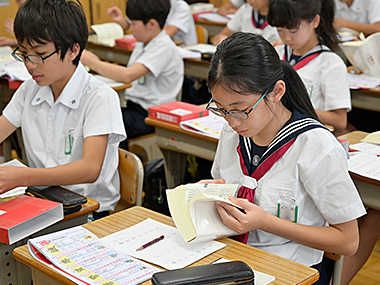
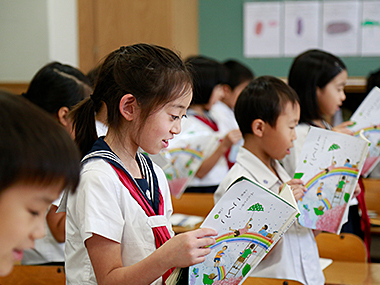
This is a picture of a class for 2nd and 6th grade students. This time, as we studied the explanatory text, we thought about the part that would be the author's argument and deepened our reading. The lessons were based on group learning and active exchange of opinions in class. By listening not only to my own opinions but also to those of my friends and sharing their opinions, I was able to gather the best points of everyone's ideas and have a deeper learning experience than if I were to think about it alone.
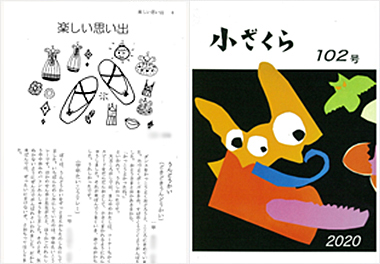
Collection of essays “Kozakura”
The literary collection "Kozakura" has been published since 1920 and reached its 102nd issue in 2019. It is published every year as a collection of essays depicting children's daily lives and events in school life. The fruitful daily lives of 1st to 6th graders are expressed in simple words.