Reading Class
Goals of Reading Class
- 1Aim to encourage the independent and self-motivated learning and reading activities of students.
- 2Enrich the learning and reading activities of students.
Points of focus
- Offer a one-hour reading time every week.
- Issue book lists and hold a variety of original library events.
Fostering independent and enthusiastic readers
A “Library” Class
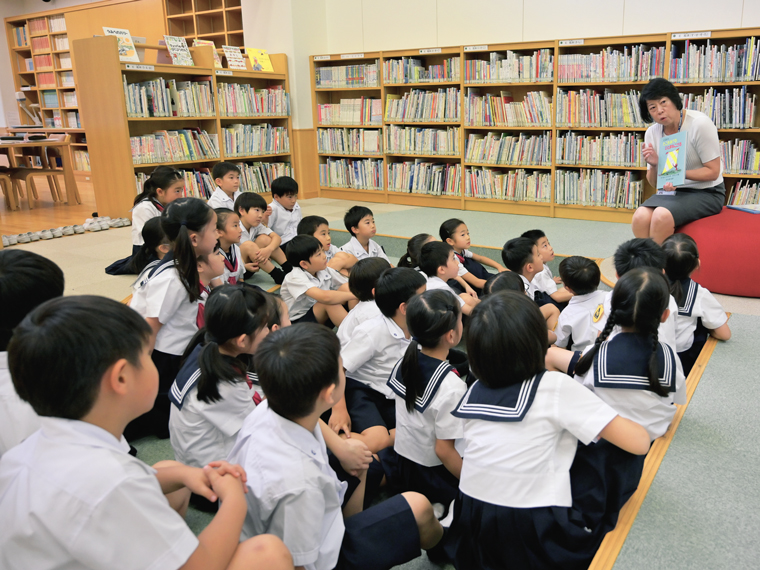
In “Library” classes, students are exposed to books on a wide range of fields. They also receive guidance about reading to deepen their knowledge and ideas, and how to use the library. They learn everything from library use rules to how books are arranged, and how to use reference books to reach information they need. The ultimate goal of this training is make students capable of researching and tackling study challenges on their own.
All the instructions we give to students are consistent with their stage of development at each grade level.
● Learning objectives for each grade
| Grade 1 | To nurture a willingness to enjoy reading easy reading materials To get familiar with books in the library |
|---|---|
| Grade 2 | To become more motivated to read easy reading materials To learn how to borrow and return library books |
| Grade 3 | o become more motivated to read a variety of reading materials To understand how the library classifies and organizes books |
| Grade 4 | To read a wider range of materials To learn library rules more deeply, e.g., the relationship between call numbers and shelf location |
| Grades 5 & 6 (Integrated) |
To cultivate deeper thinking and broader knowledge through reading To learn to use the library to research any subject of interest To develop the habit of selecting appropriate reading materials |
Booklists
To help broaden the horizons of students’ interest in reading, we create various book lists.
Especially the booklist for the Primary School Festival helps enhance the collection of books by theme.
“Wakaba Books”
These are books selected by teachers for each grade group that they would like children to read before completing their six years of primary school studies.
About 20 books are selected for each grade, focused on picture books and stories that have been familiar and widely read for many years.
“Recommended Books for Summer Vacation”
We distribute this list each year before the summer vacation in the hope that students make time for some leisurely reading during their long break from school.
In addition to stories, we try to select books on a wide range of topics, including science, biographies, and books about peace.
“List of Exhibits at Primary School Festival”
Every year, one theme is decided for the Primary School Festival and a display of books.
Copies of the list of the exhibited books are shared with students and visitors.
2018: “Let’s research the countries of Asia!”
2019: “What we can do now to build a brighter future (SDGs)”
2020: “Secrets of delicious school lunches!”
“Wakaba”, a collection of student book reviews
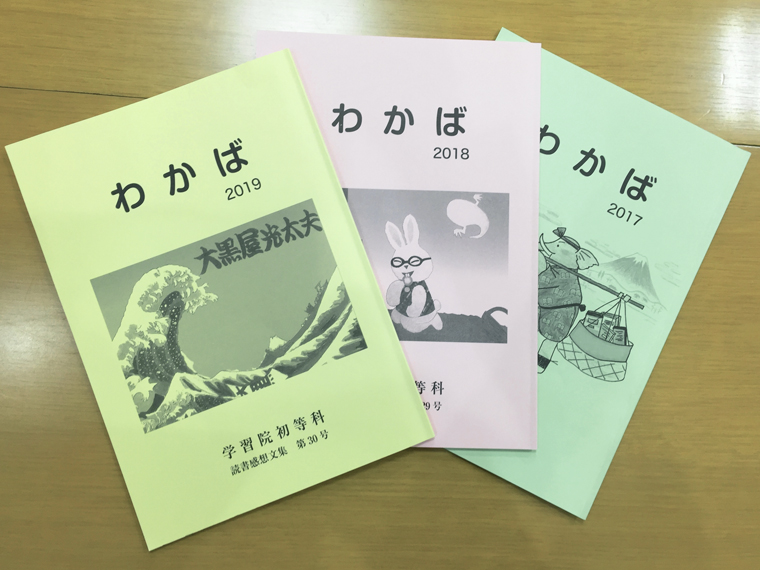
As children get into the habit of regular reading, their daily reading experiences become very rich.
During the long summer school break, in particular, students are encouraged to read many books and to write down their impressions of books that they find memorable.
The best of these book reviews and reflections by students are then published as a collection titled “Wakaba.”
Reading what their friends have written can inspire and motivate students to do more reading.
Each piece is accompanied by comments by the teacher who selected it so students can also learn how to write better book reports.
Various events of reading
Reading Week
This two-week event is held twice a year, in June and October.
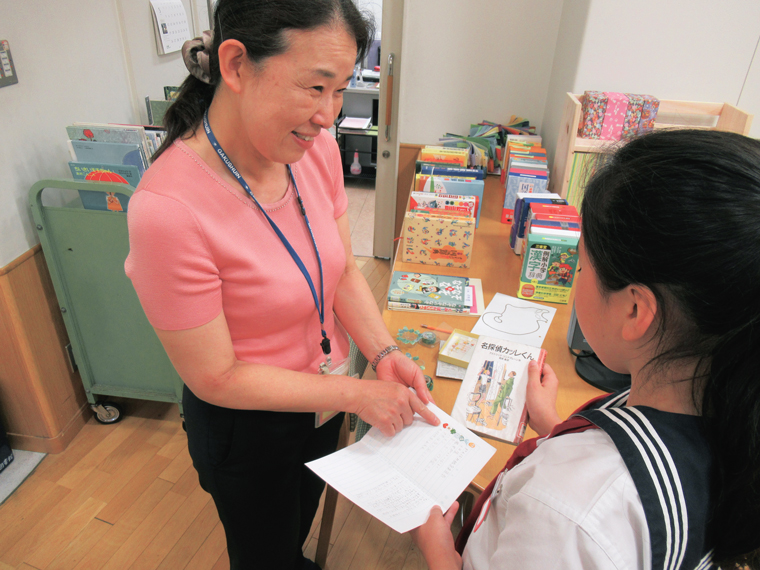
In addition to lending out more books than usual, the event includes fun projects and activities such as book readings by library committee members to younger students, a poster contest, an exhibit of book reviews by students of all grades on pieces of paper shaped amusingly like sweaters, windows, apples, and other things, reading quizzes and puzzles, and more.
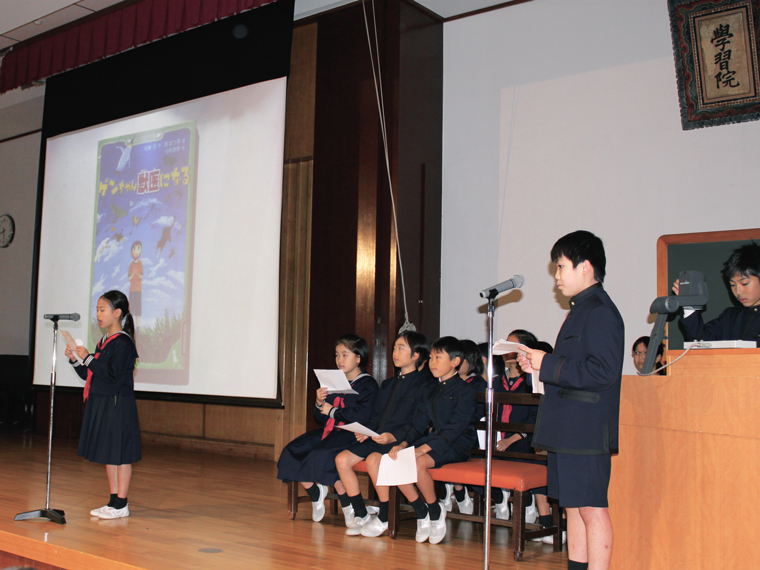
“Reading Week Assembly”
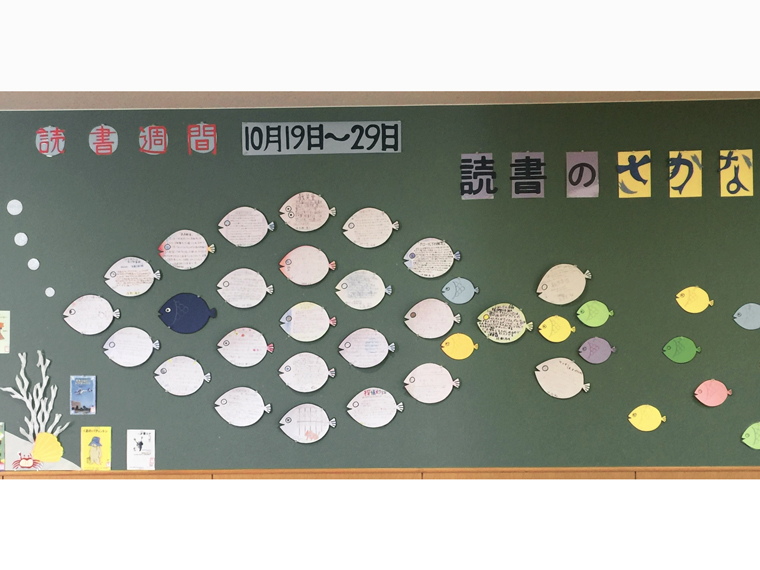
Reading Week: Book reviews on fish-shaped pieces of paper
What book will I read?
Throughout each year, students try to read through the yearly “Wakaba” books and the books on the list of books recommended by teachers for the year. As an encouragement to read the books, students receive stickers to affix to the reading record whenever they complete reading a book.
Storytelling sessions
Every year during the October Reading Week, experienced storytellers from the Tokyo Children’s Library come to the school to tell folktales and other stories to students from Grades 1 to 6 for an enriching and mindful hour.
Listening to stories read aloud is an invaluable experience that stimulates the imagination of children.
Primary School Festival
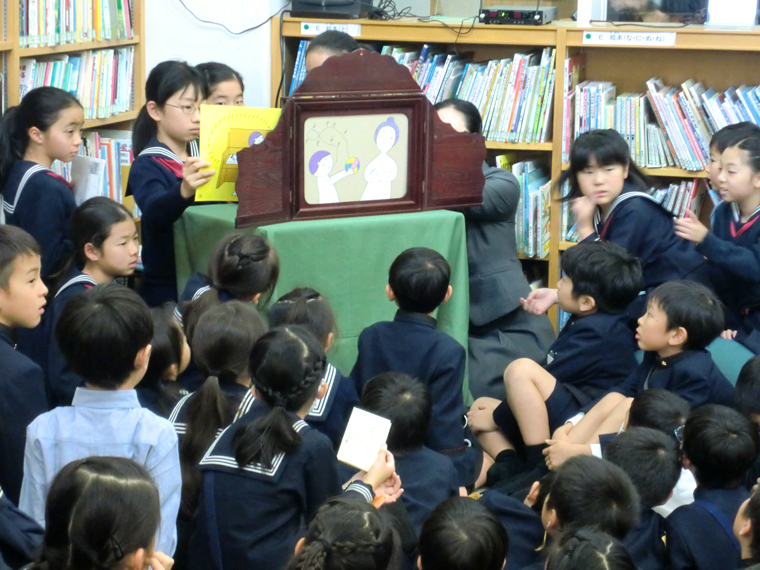
In addition to the display of books based on a theme, Library Committee members hold a storytelling performance with pictures. This event appeals to many children, especially younger students.
Good reader awards
At the end of the school year, we give awards to commend students who have read numerous books during the year, or who have met their “What books will I read?” target. Many students make use of the library to reach their goal.
Activities of Library Committee members
The Grades 5 and 6 Library Committee members are in charge of borrowing procedures and keeping the shelves in proper order. They also play a big role in promoting library activities through their involvement in events such as Reading Week, and by presenting books and reading aloud at school assemblies.
Library as research and learning base and information centre
In January 2006, a new library of approximately 400 m2 was completed. The library is always open for students, from before school starts until after school, and is run by full-time librarians and staff to support the reading activities of students.
Dedicated library computer system
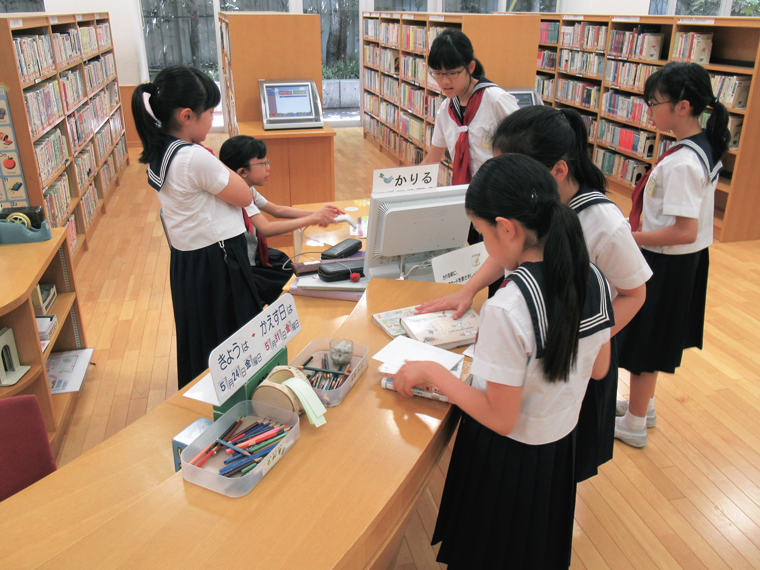
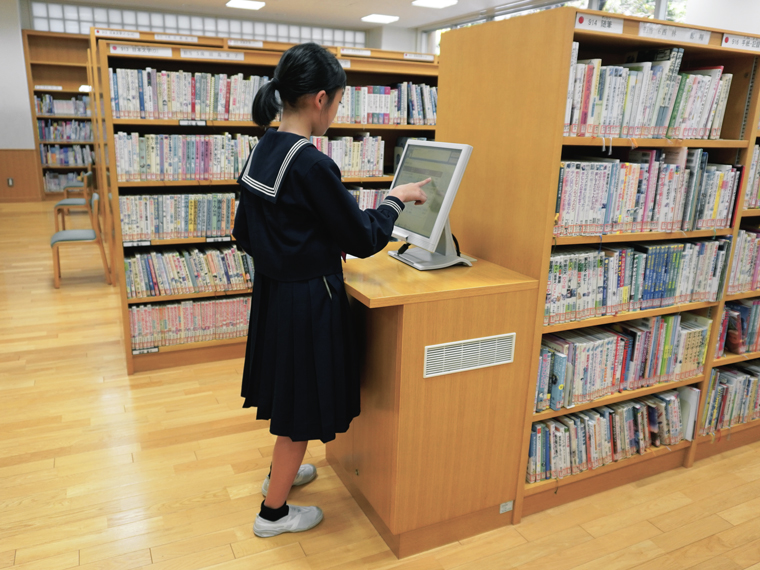
In September 2003, a computer system exclusively for the library started its operation. This made it possible to simplify the procedures for managing the library collection and for borrowing and returning books. There are five search terminals in the library, equipped with touch panels that children can operate easily. Students can instantly look up books and materials by title, author, or subject.
In addition to finding books that they want to read, children can actively use search terminals to obtain essential information for their research and study in various subjects.
We remain committed to making the school library function effectively for all kinds of learning activities, to help students to acquire and improve their ability to tackle and solve problems independently, and access essential information.
Bookshelves
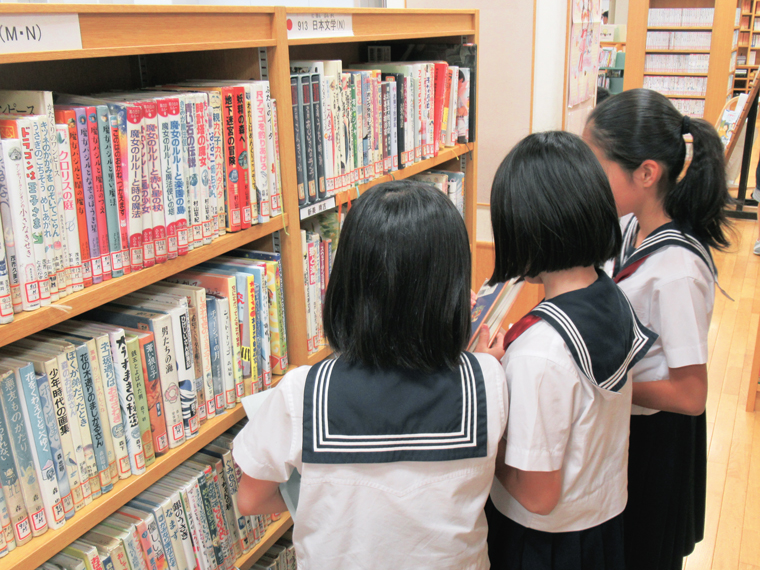
The height and arrangement of bookshelves are designed to make it easy for children to select books.
The number of bookshelves is very large, enough to hold approximately 30,000 books.
There is also a “Wakaba Book Corner,” “Reference Book Corner,” and other collections of books that make it easier for children to use the library.
Two study spaces
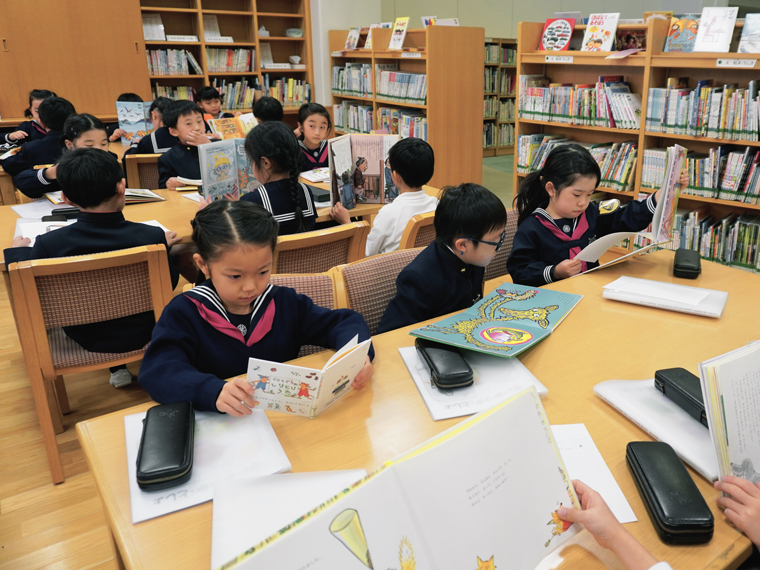
Study space for lower grades
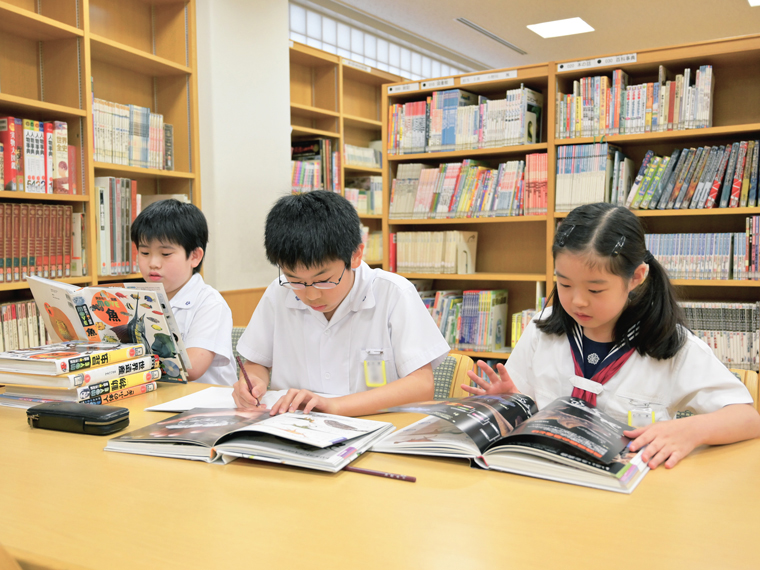
Study space for upper grades
The library features enough space to allow two classes to have a lesson simultaneously.
In one space, the desks and chairs fit lower grades; in the other space, upper grades. Each space is equipped with a glass blackboard that functions both as a screen and blackboard, as well as audiovisual equipment and LAN cables with Internet access.
Very conveniently, there is also a “Picture Book Corner” near the space for younger students and a “Reference Book Corner” near the space for older students.
Picture Book Corner
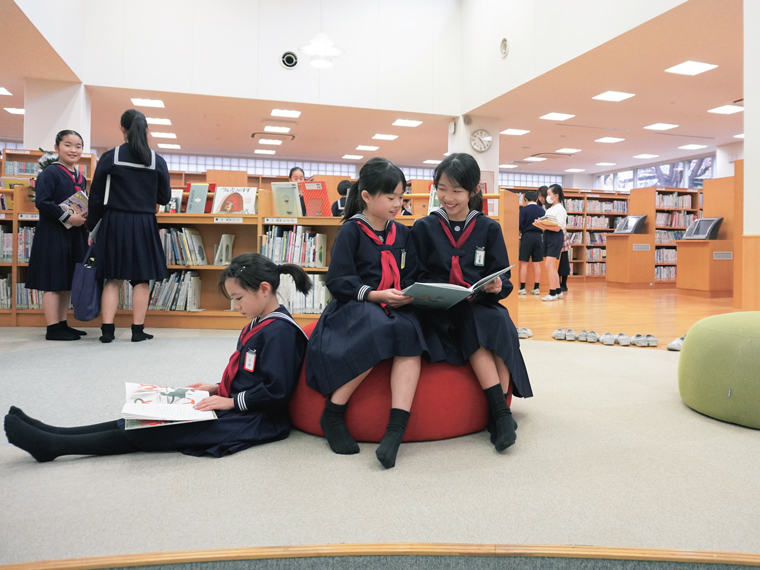
In this carpeted section of the library, students can leisurely enjoy picture books. Part of the space is terraced, to make it easier for students to listen when storytelling and book talks are held. In winter, an underfloor heating system keeps the space warm. This is a great space for children to relax in during recess.
Noticeboard
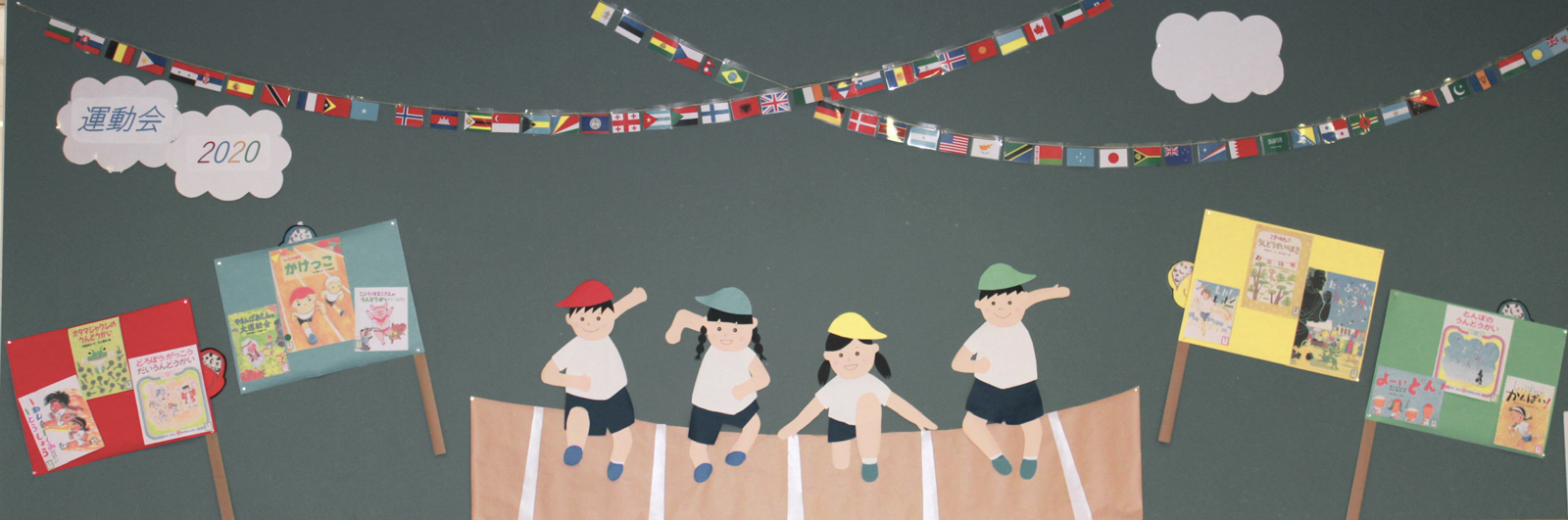
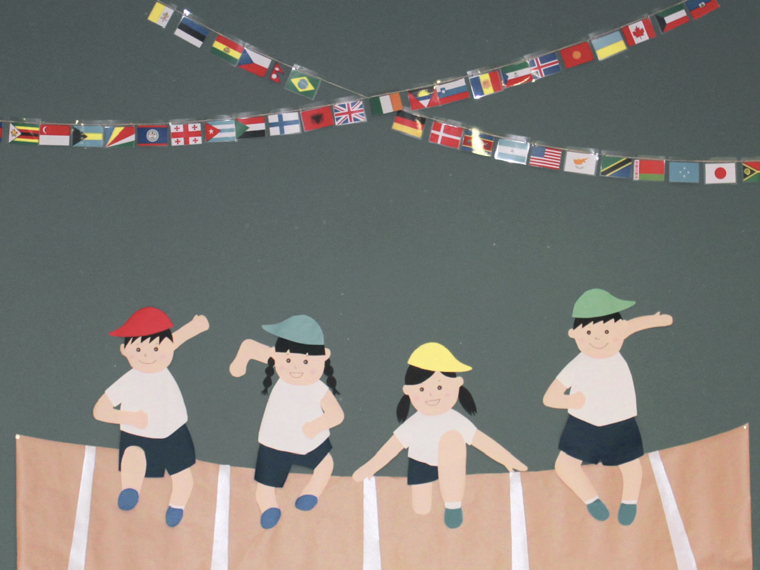
The large noticeboard space is located to the left of the library entrance. The library regularly sends out information to stimulate the curiosity of students in books on a specific theme that it has regularly selected. The idea is to try to get the children interested in books they would not otherwise consider.
Classroom libraries
The school also invests considerable effort in maintaining a comprehensive library in each classroom.
In the lower grades, students do a lot of classroom activities, so we provide approximately 480 books for Grade 1, 400 books for Grade 2, and 260 books for Grade 3.
To enhance classroom reading, we look not only at quantity but also the quality of reading materials.