Music
Goals of Music
- 1 To nurture a rich mind and spirit that strives to approach and know music for oneself through music.
- 2As the first step in music education at the elementary school level, “allow students to experience and realize how wonderful it is.” Clearly recognize the willingness of children to involve themselves with music and use this as a foundation to help them experience the diversity and wonder of music throughout their six years of schooling.
- 3 Without depending excessively on knowledge and skills, help students to work independently, while sharing their difficulties and tips with friends as they grow.
- 4In primary school music education, we aim to nurture students who are naturally ethical and moral and equip them to lead rewarding lives through music.
Points of focus
- To improve the musical abilities of students by advancing their fundamentals and basic principles and carefully building a solid body of learning in addition.
- To develop increasing fascination and interest in music.
- In Grade 3, to conduct team-teaching classes once a week to amplify individual guidance.
- To hold school-wide or grade-wide musical concerts. Provide an opportunity for performances with parents to allow students to enjoy musical expression even more deeply.
- From Grade 4 onward, organize special performances of traditional Japanese music for students, to provide them with an opportunity to hear and see traditional Japanese music and to appreciate the culture that has been handed down by their ancestors.
Grade 1 students
In Grade 1, students learn basic music skills such as singing together in unison, maintaining a rhythm, and playing a keyboard.
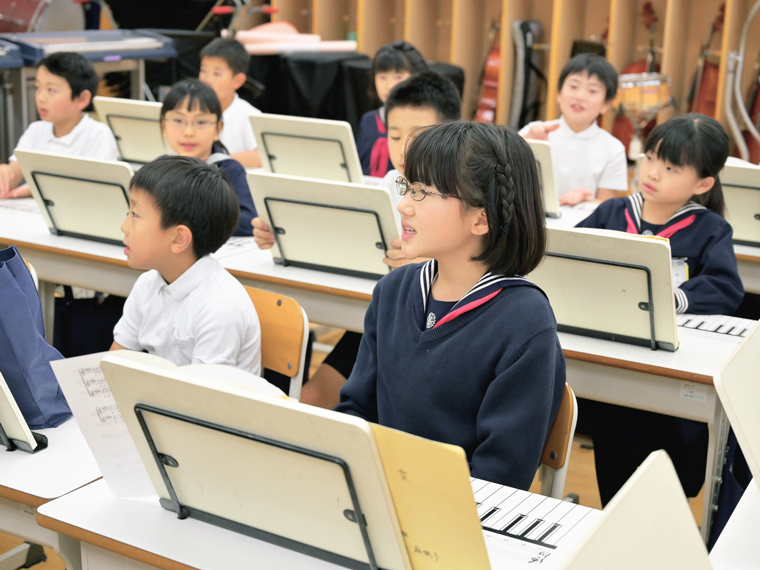
To learn to sing, students try to sing numerous songs. In addition to the songs in the textbooks, they sing many songs that are seasonal or of interest to Grade 1 students (about 80 songs per year). The songs are not limited to contemporary Japanese songs. Time permitting, students sing songs from a variety of countries to broaden their repertoire.
Song lessons begin with reading lyrics aloud. As students read the words aloud, they pay attention to pronunciation and nasal sounds. Next, they sing phrases one by one with sound. Then finally, they sing all the way through a song. Students are also encouraged to listen to each other’s singing.
Instrumental instruction follows a keyboard harmonica textbook that is used for six years.
Students also perform many simple ensembles consisting of bells, castanets, tambourines, small and large taiko drums, xylophones, and glockenspiels. Using such a variety of instruments allows the students to experience both the fun and difficulties of ensembles, as well as the sense of accomplishment of completing a piece of music.
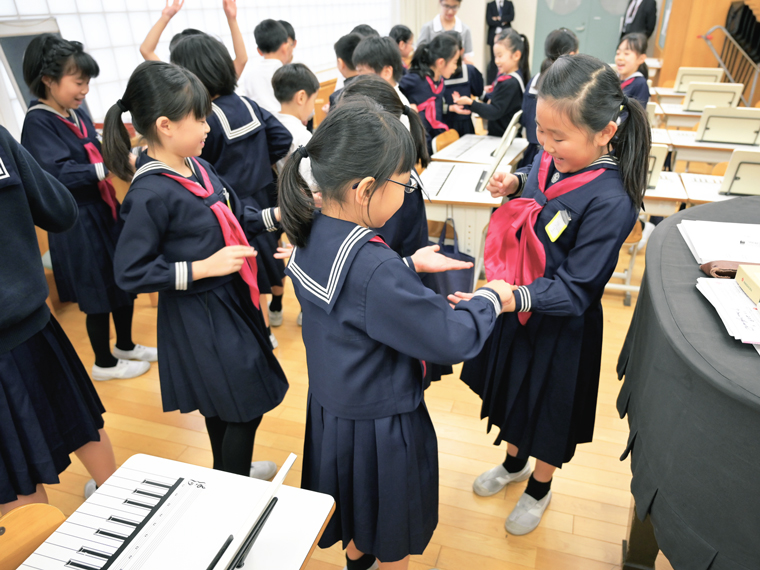
We also offer a variety of rhythm learning methods that involve games.
Grade 2 students
For Grade 2 students, classes are developed to enable them to grasp and sense the elements and structure of music, building on what they learned and worked on in Grade 1. At the same time, we aim to enhance their emotional sensibilities.
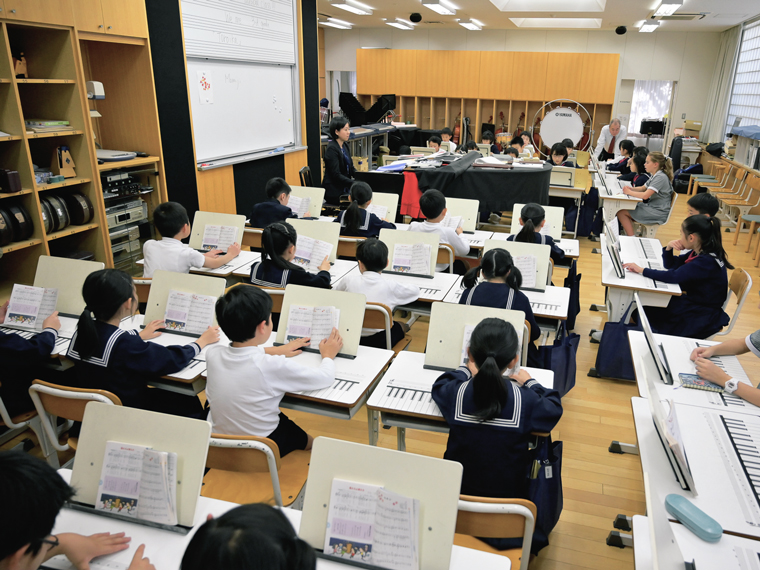
For example, they learn to express and savour the anticipation of events and the seasons through songs related to events such as the Sports Day and field trips. Each student also strives to become even better at whatever they are naturally good at. Otherwise, they try to overcome their lack of ability and develop their skill.
Singing progresses from singing in unison to alternating and sharing parts of the melody line. Students also sing circle canons (rounds). They learn how to listen to rhythms and melodies, how to count beats, and the rules of musical notation and scores, according to their developmental age.
Our students naturally enjoy attending their music classes through these activities.
Grade 3 students
Unlike Grade 1 and 2 students, who experience the joy of playing in ensembles, Grade 3 students need to gradually raise their level of technical skill. The first step in this process is learning to read musical scores.
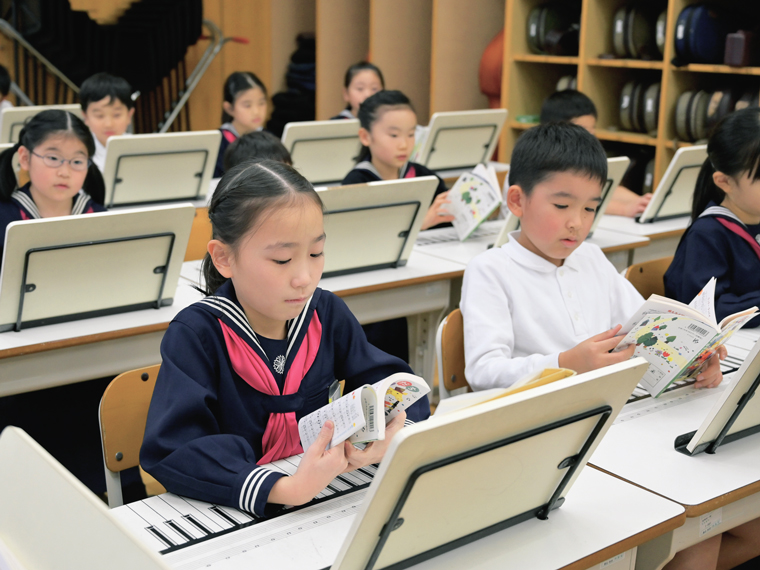
The ability to read music improves students’ concentration and makes repetitive practice easier. This is also where we introduce the recorder. Students learn the recorder by following an original textbook developed by Gakushuin Primary School.
In the third term, students work on duets of recorder and keyboard harmonica. With the addition of the violin, they also experience ensemble playing.
In their singing, they start working on a two-part chorus.
One of the two classes each week is run as a “pair class” led by two teachers. This allows us to provide the students with technically detailed musical guidance.
Grade 4 students
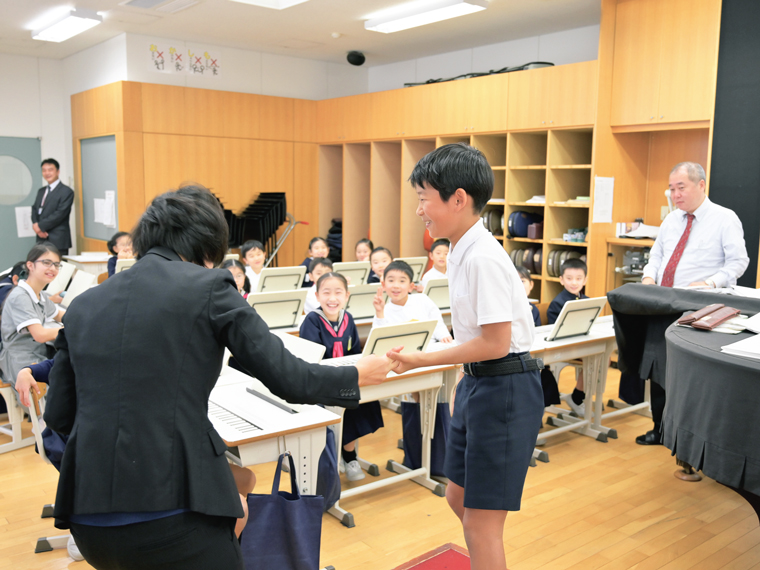
By the start of Grade 4, students have been learning the recorder for a year. Some can play simple melodies easily, even without looking at scores. During this year, students copy and learn from their more skilled friends and challenge themselves to play a variety of tunes.
Ensembles are not limited to the recorder. They now include keyboard harmonica, xylophone, glockenspiel, and percussion instruments. By identifying the parts that play the rhythm and the parts that play the chords of well-known pieces, students learn about the structure of ensemble music. The students discuss the parts they are responsible for within the group. When their parts do not fit in, they continue to practice patiently with the whole ensemble. Finally, they perform at a concert for parents. Our goal is to make the process of learning through cooperation with others and steady effort more enjoyable.
Since students start studying English in Grade 3, we also challenge them to sing English songs. It is more difficult to match the lyrics, melody, and rhythm in English songs compared to Japanese ones. For this reason, an English teacher helps to make sure that the students can learn to sing to the beat.
In Grade 4, students can join the Orchestra Club. This allows students to work not just with keyboard harmonica and recorder ensembles but also with violins, flutes, trumpets, and other orchestral instruments.
In Grade 4, students also participate in an annual event featuring performances of traditional Japanese music. This event is divided into three categories of traditional Japanese music: (1) Gagaku, the traditional Japanese musical instruments (2) Nohgaku and Shimai, the dance and singing stage performance; and (3) strings music centred on the koto and shamisen. Every year, students enjoy one of them and see all three by the end of Grade 6. It is a precious opportunity to experience traditional Japanese performing arts in an intimate setting.
Grade 5 students
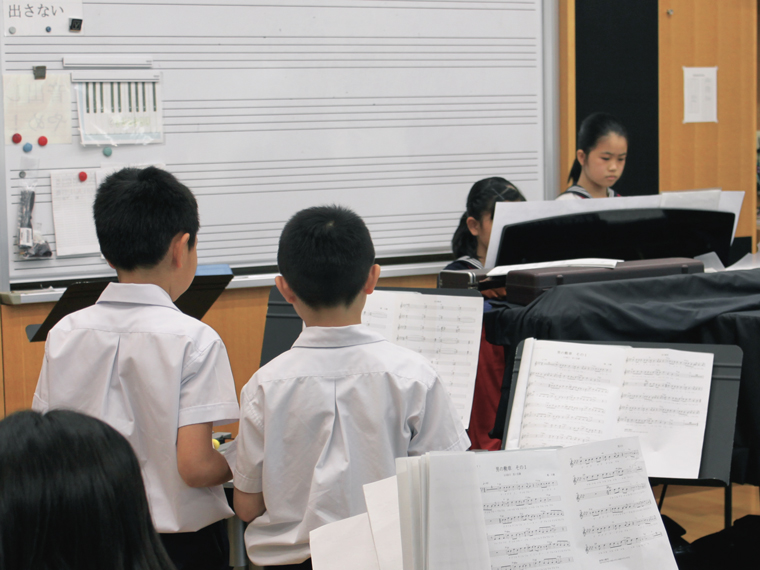
In Grade 5, students demonstrate further growth in their musicality. The focus in singing lessons shifts from singing in unison to a two-part chorus, while in instrumental ensembles, a greater variety of instruments are used for musical performances.
With classes like this, we push the musical level of the students higher and allow them to experience the challenges and joys of performing in front of audiences.
When working with ensembles of a high musical level, it often happens that practising only performance pieces does not result in a high level of perfection. For this reason, the students practice a completely different type of musical piece at the same time.
Specifically, students break up into small groups of four to six, and each is provided with an instrument and part. All the parts are then played in turns by each student in the group.
This exercise helps the students to understand each part better and to perform the piece more confidently.
Grade 6 students
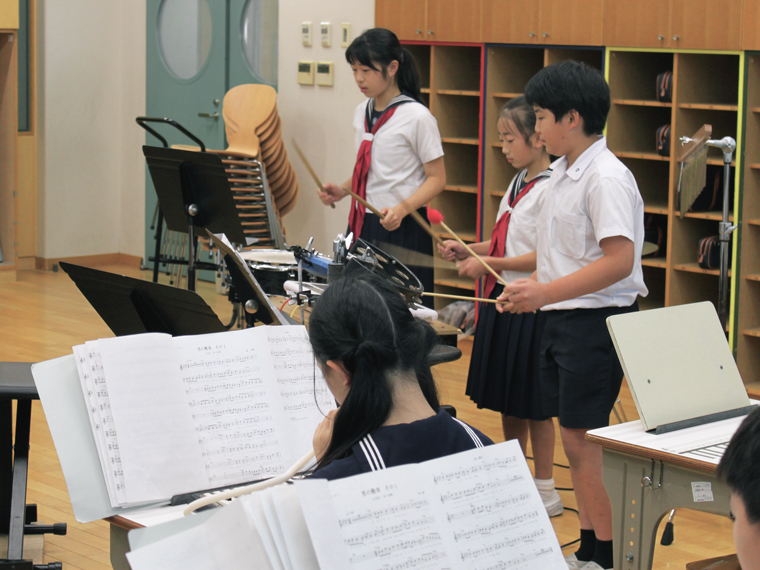
In this final year, students integrate everything they learn over the six years of musical education. To achieve a higher level of musicality in this highest grade, the lessons are designed to achieve the following:
- To learn to sing while mentally picturing and imagining scenes.
We actively work on songs written by our predecessors, such as “Oboro Tsukiyo” (Misty Moonlit Night) and “Ware Wa Umi no Ko” (We are Children of the Sea), by the Ministry of Education. We hope to see students develop a rich sensibility and spirit and grow to become broad-minded modern people. - To become familiar with well-known songs in foreign languages.
Students work not just on Japanese songs but also on other popular music from around the world.
As their English ability advances, students become more interested in English musical works. - To expose students to the works of the major composers in music history and get them to listen to performances of various genres of music from different periods.
As they familiarize themselves with the names and works of major composers and gain a deep appreciation of their characteristics, they learn about historical trends, such as Baroque, Classical, Romantic, and Impressionism. - To get students to play the themes of outstanding musical compositions on the recorder and other instruments they have learned.
Students learn to hum the melodies of famous pieces without even realizing it.
- To learn to sing while mentally picturing and imagining scenes.
We actively work on songs written by our predecessors, such as “Oboro Tsukiyo” (Misty Moonlit Night) and “Ware Wa Umi no Ko” (We are Children of the Sea), by the Ministry of Education. We hope to see students develop a rich sensibility and spirit and grow to become broad-minded modern people. - To become familiar with well-known songs in foreign languages.
Students work not just on Japanese songs but also on other popular music from around the world.
As their English ability advances, students become more interested in English musical works. - To expose students to the works of the major composers in music history and get them to listen to performances of various genres of music from different periods.
As they familiarize themselves with the names and works of major composers and gain a deep appreciation of their characteristics, they learn about historical trends, such as Baroque, Classical, Romantic, and Impressionism. - To get students to play the themes of outstanding musical compositions on the recorder and other instruments they have learned.
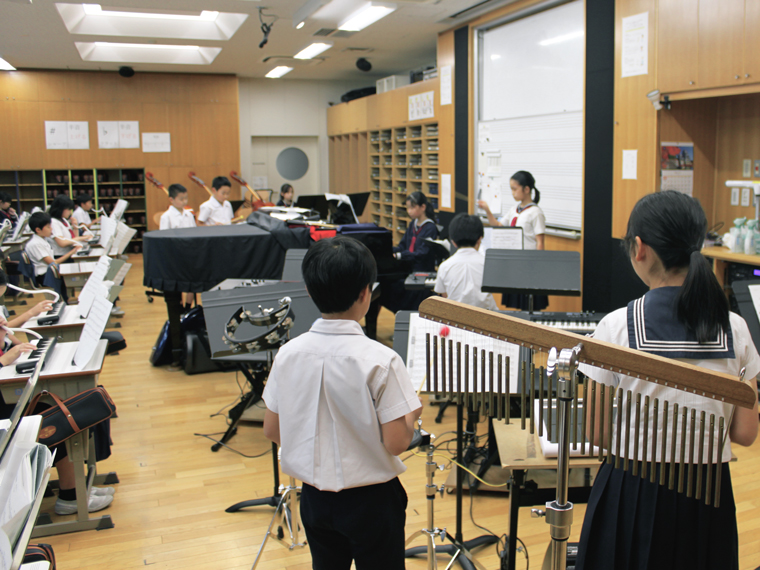
Students learn to hum the melodies of famous pieces without even realizing it. - To get students to listen to each other’s rhythms and melodies and to play them creatively and expressively.
Students learn to sing and play solo, as well as to enjoy the special sound of harmonizing with many friends. By listening to each other’s rhythms and melodies as they play, students develop an understanding of the structure and composition of music through their senses. Learning to respect the sounds produced by others also helps them to maintain a balance in group music performances.