Science
Goals of Science
- 1 To become familiar with nature and develop a love for it, and also to develop the ability to think deeply about the future of the global environment and the precious value of life.
- 2To learn how to express one's own ideas, by developing a deeper understanding of natural things and phenomena and acquiring a scientific way of looking at and thinking about them.
- 3To become more skilled at problem-solving by conducting experiments and observations with vision and imagination.
Points of focus
- To concentrate on fostering a love for nature, in addition to emphasizing activities that make students more familiar with nature.
- To strive to foster logical thinking through discussion and debate. And to focus also on note taking skills.
- To carefully ensure that students are very familiar with experiments, observation, and other essential methods of science.
- To conduct activities for fostering an interest in cutting-edge science, as part of Gakushuin's integrated educational program.
Experimenting and observing
In the science lab
Experiments and observation are the essence of science. Through direct contact and interaction with natural materials and phenomena, students deepen their understanding and appreciation of nature. For this reason, we think very carefully teaching materials and creative teaching methods.
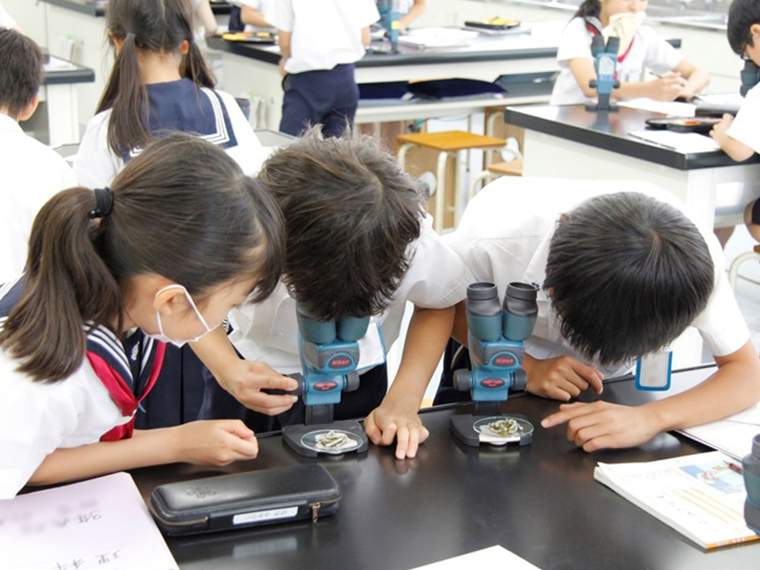
Grade 3: Observing silkworm moth larvae
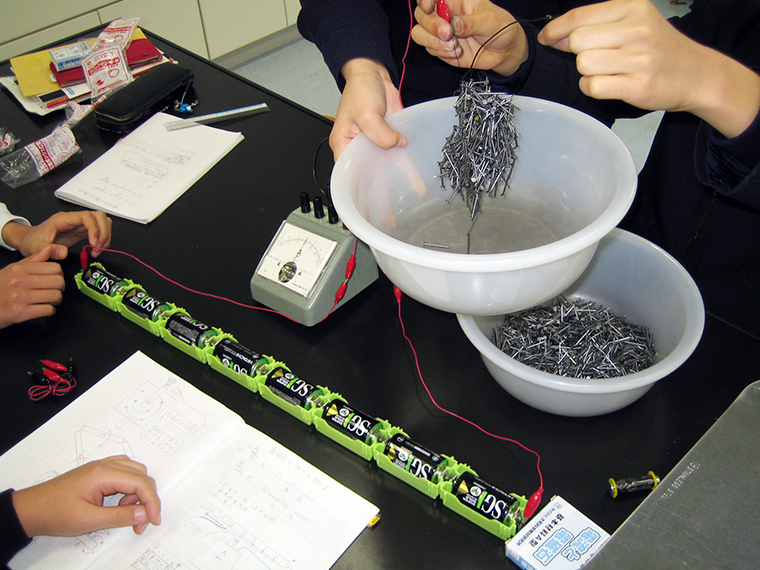
Grade 5: Electromagnet experiment
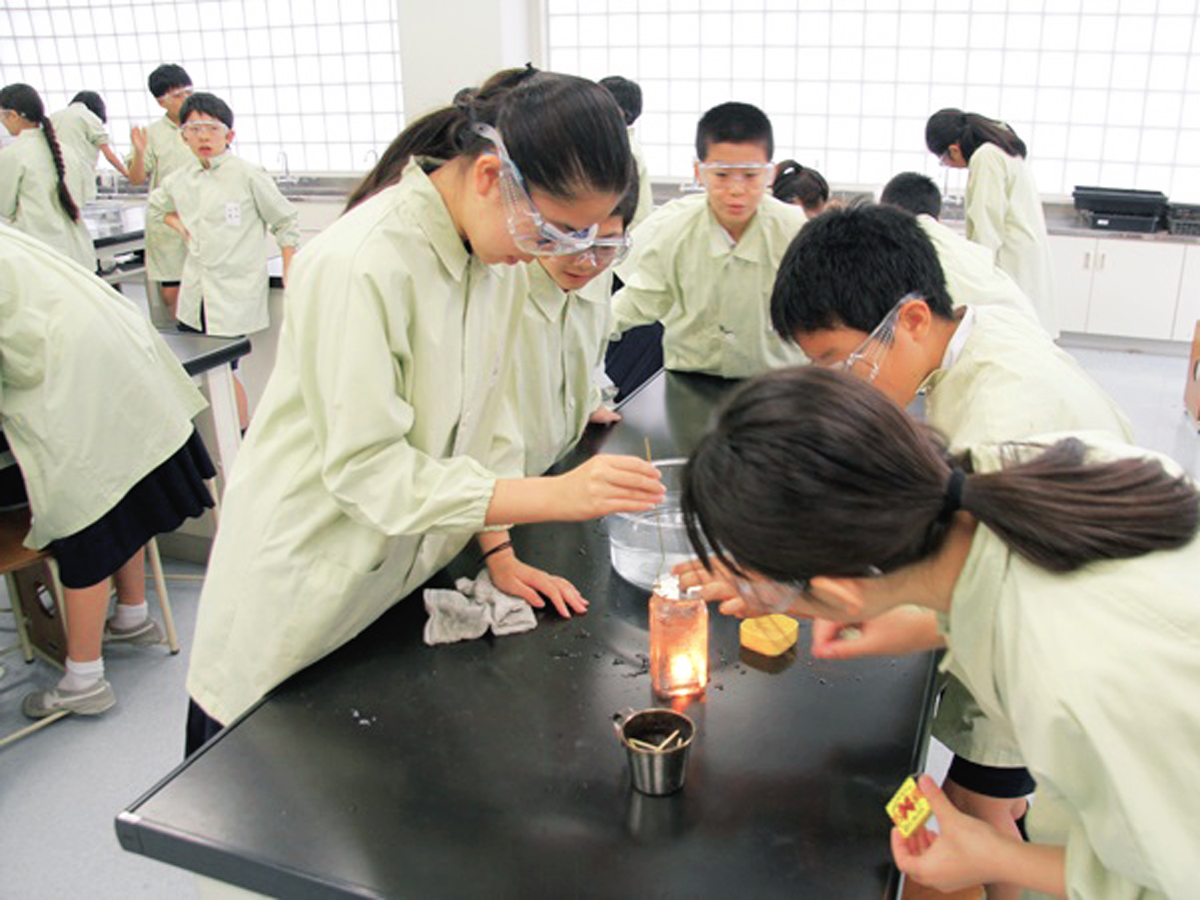
Grade 6: Combustion experiment
At Kinkoen Garden and on the school grounds
Science activities are not confined to the science classrooms or labs. Students also explore a wide variety of materials and places outdoors, on the school grounds, in the Kinkoen Garden, and even off campus. By observing the trees on the school grounds and the familiar plants of Kinkoen Garden, students learn the seasonal rhythms of the plant world. For example, we help them to realize that there are many kinds of wildflowers, commonly known as “weeds,” which have certain mechanisms and forms that help them to survive as plants. Encouraging students to pay attention not only to the toughness of wildflowers but also to their beauty helps to make them more familiar with and respectful of the tiny lives of plants. This, in turn, helps students to develop a genuine love for nature.
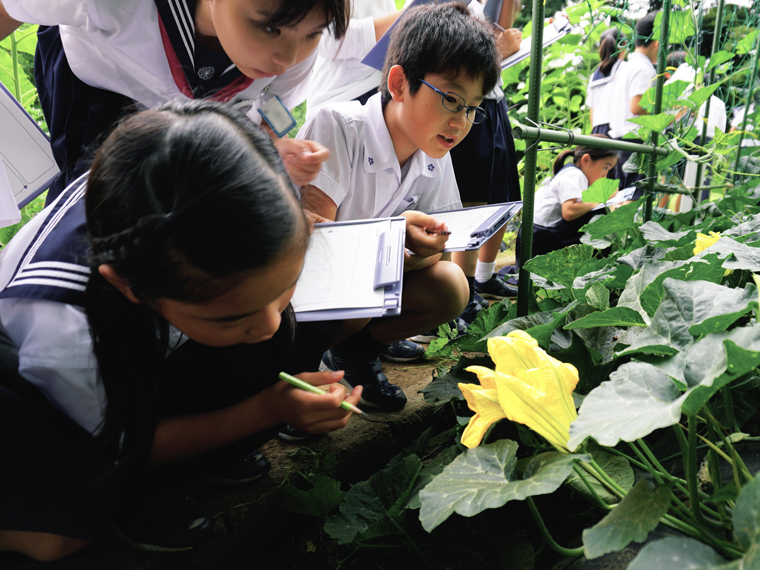
Grade 4: Observing Naito pumpkin flowers
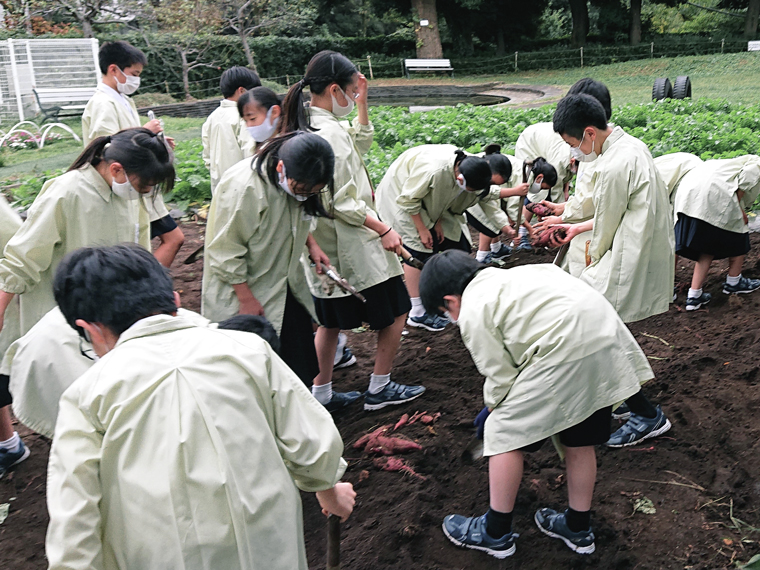
Grade 6: Harvesting sweet potatoes
Despite its relatively small size, Kinkoen Garden contains beds for flowers, as well as fields for growing farm crops. These fields are used to cultivate vegetables and other plants, mainly during science classes and the morning “Wakaba” hour. In addition to scientifically observing and understanding plants, the students, who spend most of their time in the city, get the chance to see how the agricultural products they consume as food are obtained. The harvested produce is used as ingredients for home economics cooking classes and school lunches. Sometimes, this activity inspires a change in the attitude towards tastes of vegetables that children may dislike. It also serves as an opportunity for students to learn the value of growing and harvesting vegetables with their own hands and to experience the joy of eating them.
Field trips
On field trips, we encourage students to experience nature directly with their own senses, through activities that can only be done outdoors, making good use of the richness of the local natural environments featuring the sea, mountains, and rivers.
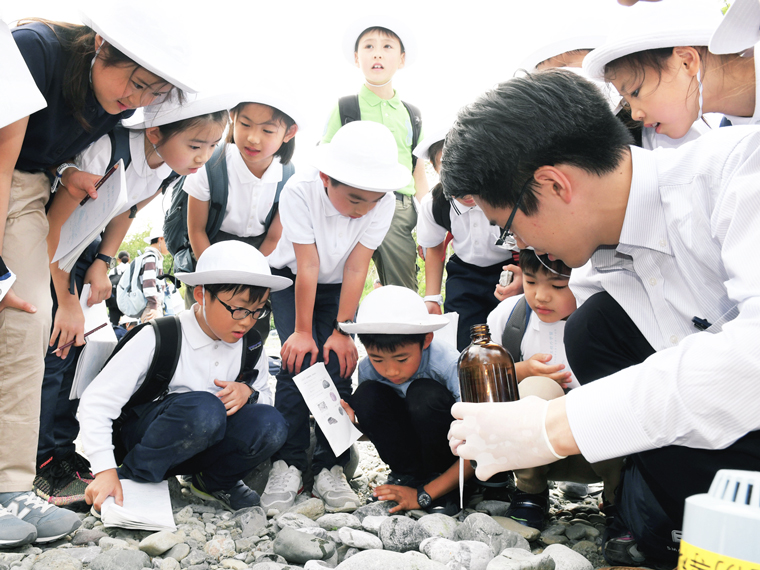
Grade 3: Observing stones (Saitama)
In Grade 3, activities are conducted around the middle reaches of the Arakawa River in Saitama Prefecture. Observing flowing rivers and the stones in riverbeds, students can appreciate how profound the action of running water can be over vast periods of time. Due to the limestone areas upstream, limestone rocks are commonly observed on the banks of the Arakawa River. As they become aware of limestone’s unique ability to dissolve in acids, students also learn about the geographical features of limestone caves and acid rain. We also try to stimulate a broader interest in rocks and minerals.
In Grade 4, students observe marine wildlife while playing on the beach in Chiba Prefecture. It is amazing to discover how many different creatures inhabit even the tiniest tide pools and rock surfaces. Touching with their own hands and seeing with their own eyes, students can better understand how these living things have adapted to and survived in their marine environment. As well as learning in the field, we also encourage students to take their time in observing and understanding the natural environment by creating specimens out of the items they collect and take home.
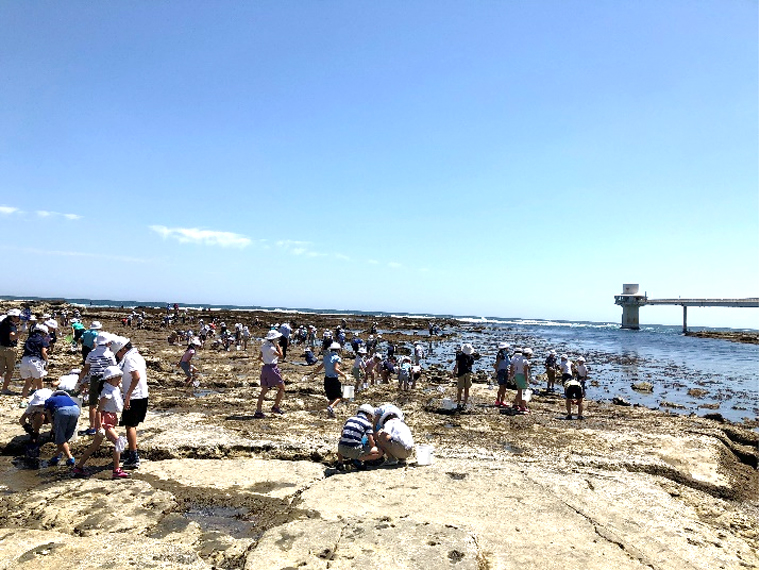
Grade 4: Observing wildlife on the seashore (Chiba)
Students prepare specimens by looking up the species of shells they collect in an illustrated reference book, creating labels, and organizing the specimens. Through this activity, students get experience in natural science research methods, such as collecting and making specimens. They also learn the meaning of species names (Japanese and scientific names). Their finished specimens are displayed at Primary School Festival events for many people to see.
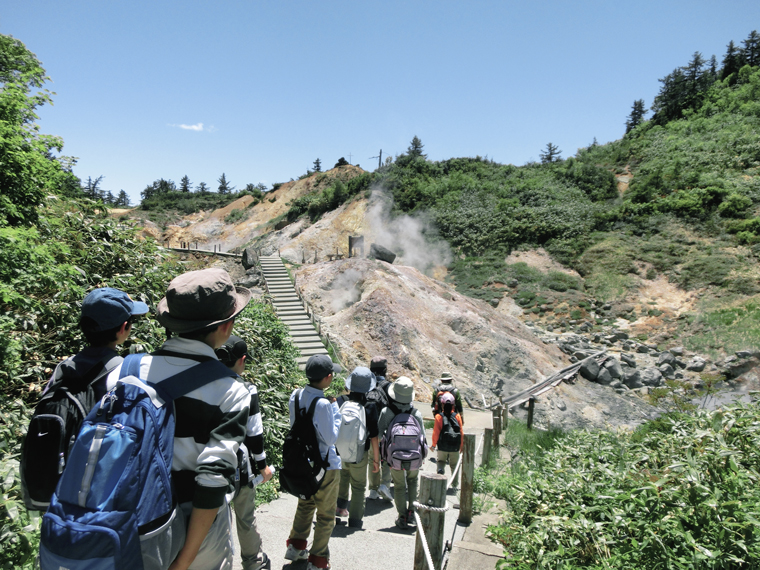
Grade 5: Observing volcanic activity (Fukushima)
Students in Grade 5 go hiking at Mt. Bandai (Aizu Bandai) to observe the nature of mountains, such as forests and highlands, which differ from that of plains. By climbing Mt. Bandai and observing Lake Hibara and Goshikinuma Ponds, which were formed when the Nagase River was dammed by an avalanche of debris, students get to see and understand firsthand how the remarkable nature around them was formed after the eruption of Mt. Bandai in 1888.
In Grade 6, students observe marine plankton during the Swimming Camp in Numazu in Shizuoka Prefecture. They get the rare opportunity to carefully observe marine plankton under a microscope. Seeing the many different shapes of plankton and learning about biological diversity, they are amazed at the fact that much of the wildlife that inhabits the sea depends on the support of these microscopic creatures.
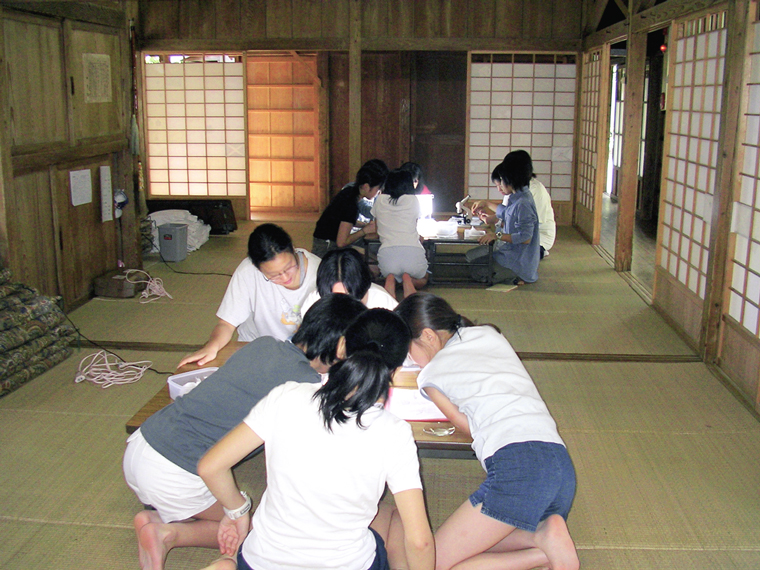
Grade 6: Observing plankton (Numazu)
On field trips that involve overnight stays, students observe the stars and constellations of the season before bedtime. They observe the Pole Star in the northern sky, the Big Dipper, which also serves as a mark for locating the Pole Star, the long Spring Triangle that extends from the Big Dipper to Spica in the constellation of Virgo in the southern sky, and Leo, which signals the arrival of spring. Students also observe Venus, Mars, and Saturn, which can all be seen with the naked eye.
All observation and collection activities are conducted carefully to avoid causing any damage to the local nature.
Students’ voluntary researches
Though not directly connected to any school classes, many children spend their yearly summer vacations voluntarily pursuing science research. The work they produce is displayed together at the Primary School Festival in the fall. Printed copies of submitted research reports and work presentations are also distributed to the whole school. This is a great opportunity for students to experience the sense of accomplishment and fulfilment that comes from doing their own research, as well as to develop new interests by seeing the various research projects and findings of their friends and peers. This independent, voluntary research is typically of a high quality, sometimes even earning recognition beyond the school in competitions.
Discussion and debate
Understanding the fundamentals of phenomena
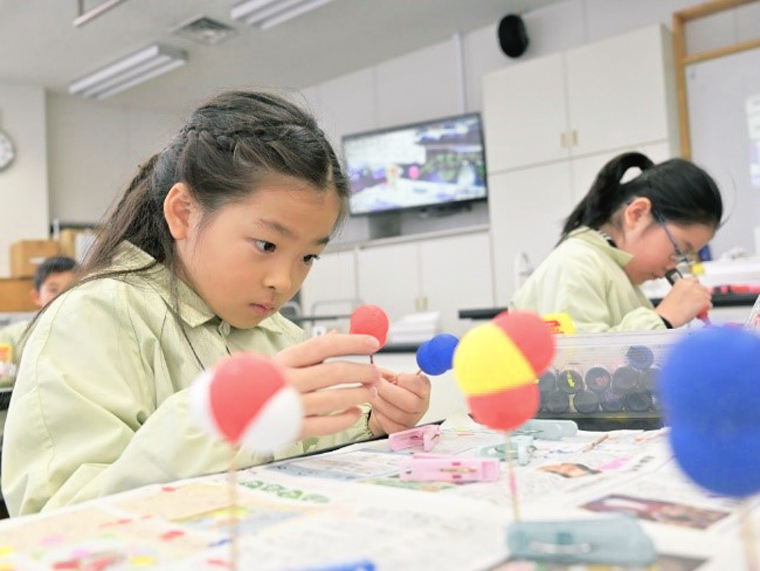
Grade 3: Atoms and molecules
In accordance with the governmental guidelines for school curriculums, learning content is divided into two domains: “matter and energy” and “life and the Earth.”
However, on account of fostering students’ scientific viewpoints and thinking, and promoting a deeper understanding of nature, we have also developed our own unique curriculum, taking into account the thinking, awareness, and stage of development of students. To get students to understand natural phenomena at the atomic and molecular levels and to grasp basic concepts such as the law of conservation of mass at an elementary school level, we incorporate additional content that is not provided in the Course of Study and have created special study modules for this purpose.
An example is the “What if We Could See Atoms?” module in Grade 3. By building models of molecules at a scale 100 million times larger than real molecules in the atmosphere, students can visualize the world of matter in terms of atoms and molecules.
We strive to foster logical thinking through discussion and debate. Students are presented with problems and asked to make predictions about them, stating their reasons to each other. After points of contention are clarified through repeated debate, the students conduct experiments to move closer to grasping a solution to the problem.
Another aspect we focus on is getting students to take notes effectively. We basically leave notetaking up to students, but we carefully read through submitted notebooks and write comments on them. This also serves as a method of communication between the students and teachers.
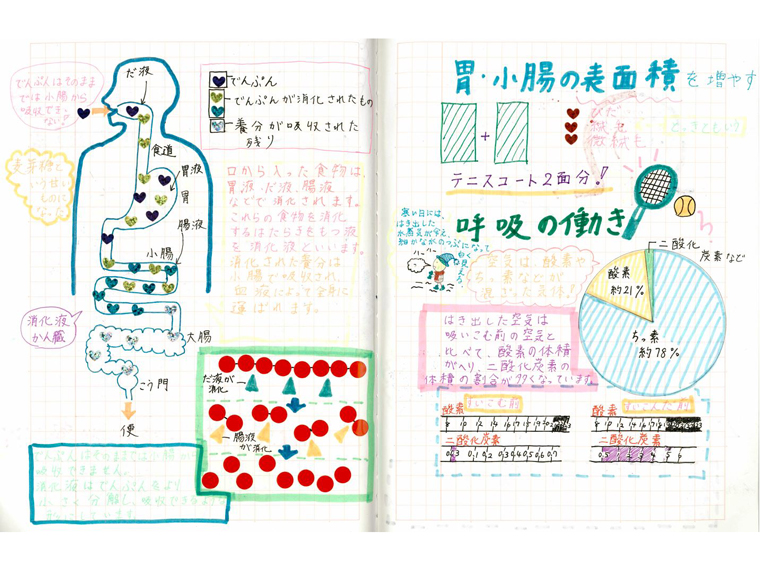
An example of a student’s notebook
Through writing, children can deepen their logical thinking and awareness of nature at their own pace, which tends to stimulate further interest and motivation. Examples of good research and summaries can be used by other students as references. At the same time, sharing examples of good notes helps to broaden interest in nature.
Gakushuin Integrated Education Program
Through classes such as “Research Workshop” and “Electron Microscope Workshop” at the Gakushuin University Faculty of Science, we take advantage of the unique benefits that only an integrated school can offer.
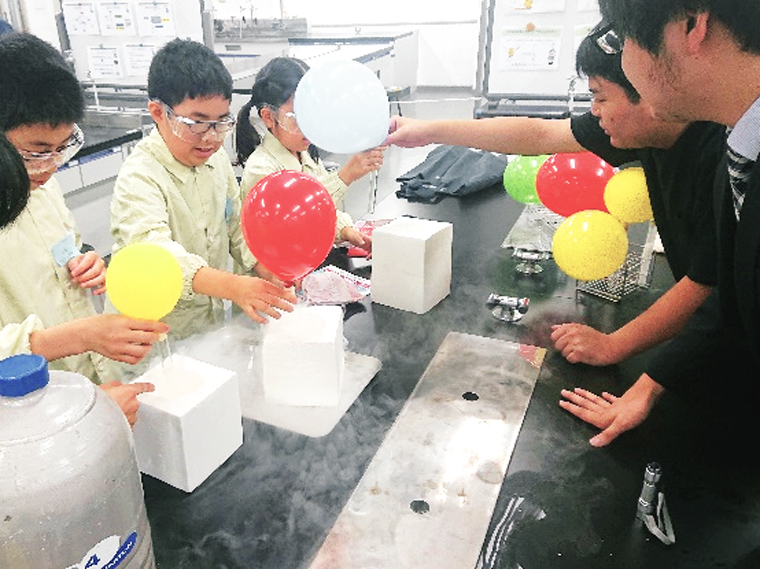
Research Workshop
“Research Workshop” is an experiment class held during the summer vacation for upper primary school students thanks to the concerted efforts of the Department of Physics, Department of Chemistry, and Department of Life Science of the Faculty of Science at Gakushuin University. Many undergraduate and graduate students, as well as university professors, participate in the classes, forming teams and letting the Primary School students conduct various experiments. Children show great interest in the experiments, which make good use of the special equipment and chemicals available in university science departments. They could never have such experiences in their primary school science classes. Discovering how enjoyable and fascinating scientific experiments can be helps the students develop a stronger interest in science.
The “Electron Microscope Workshop” for upper primary school students is held every year during summer vacation in cooperation with the Japanese Society of Electron Microscopy Technology for Medicine and Biology, a number of electron microscope-related companies, and the Faculty of Science of Gakushuin University. Students bring in various objects that they have found interesting in their preliminary studies, and under the close guidance of experts, they view them under an electron microscope, operating the equipment themselves. Observing three-dimensional images of the world magnified tens of thousands of times allows them to see the wonders of the natural world from a microscopic perspective. Even the most familiar objects look completely different under an electron microscope, even compared to how they look under a magnifying glass or optical microscope. This experience gives students a greater curiosity and sense of wonder about the mysteries of nature and science.
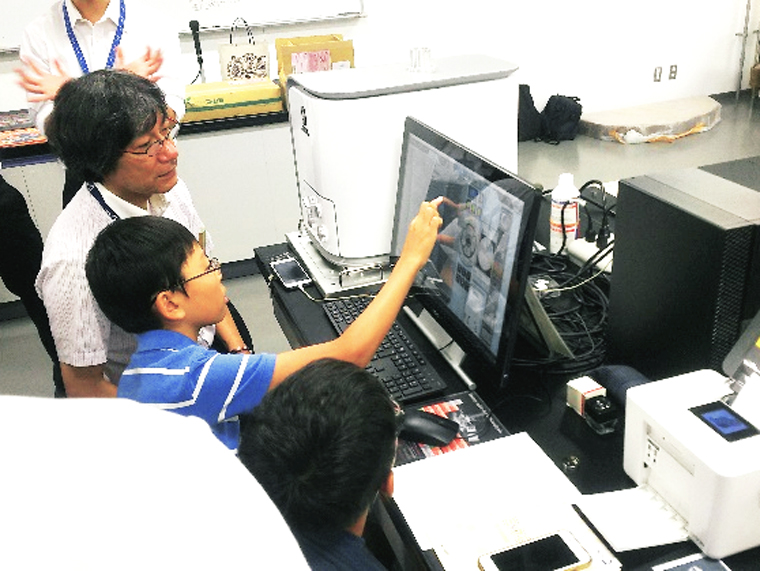
“Electron Microscope Experience” class
Since both classes are held during summer vacation, attendance is optional, but a large number of students participate every year.